Literacy Pathway
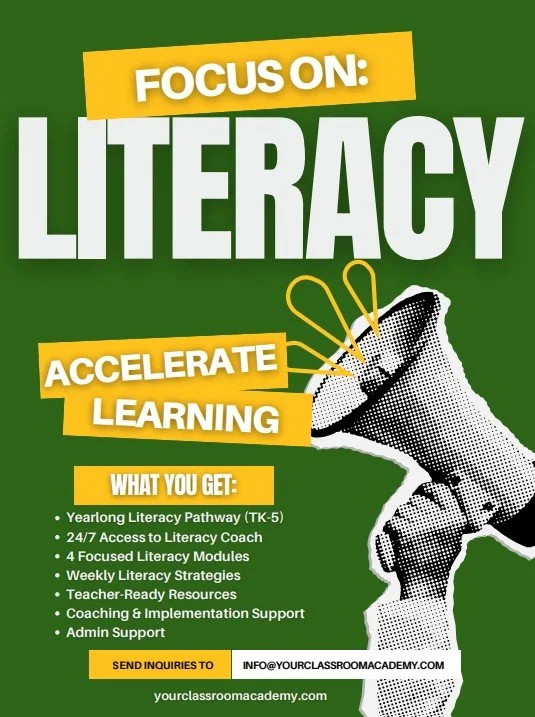
A yearlong Literacy Pathway for TK-5 teachers focused on evidence-based reading instruction, classroom-ready strategies and sustainable teacher growth.
Program Details
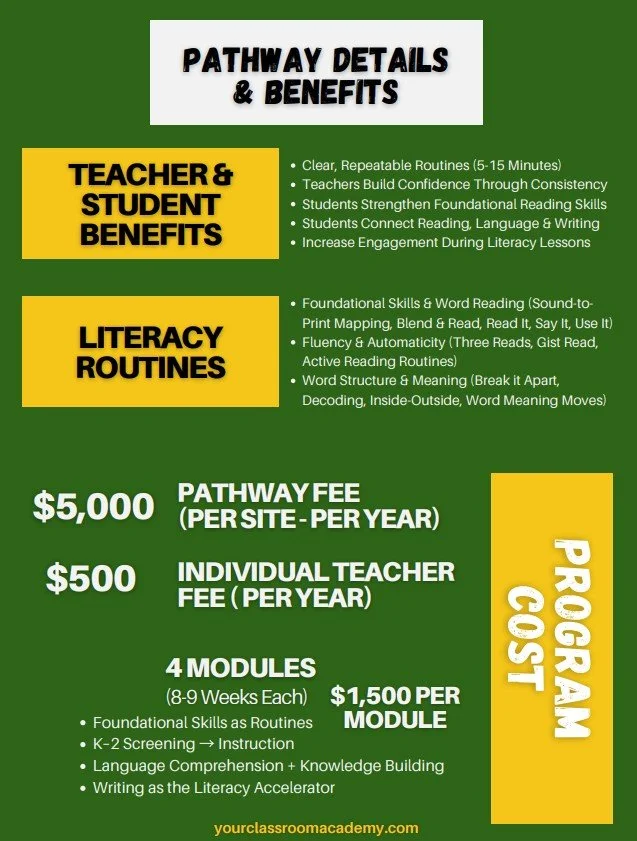
The Literacy Pathway includes research-aligned literacy strategies and instructional routines designed to support reading comprehension, vocabulary development, and student engagement across content areas.
Active Reading Strategies (TK-5)
Vocabulary Development Routines
Explicit Instruction in Reading Comprehension
Reading for Meaning Strategies
Literacy Routines for Diverse Learners
Scaffolds for Struggling Readers
Collaborative Structures Around Text
Literacy Modules

The yearlong Literacy Pathway is divided into 4 modules to provide focus for teachers and coaches. Explore each module below.
-
This module focuses on strengthening the foundational skills students need to read accurately and confidently, without turning instruction into a rigid program or disconnected drills. Teachers learn how to embed phonological awareness, phonics, word reading, and fluency into short, high-impact routines that fit naturally into their day.
Rather than introducing “one more thing,” this module helps teachers refine how foundational skills are taught and practiced: consistently, efficiently, and developmentally appropriately.
Instructional routines include:
Oral sound and word stretching
Sound-to-print mapping
Blending and word reading routines
High-frequency and academic word work
Fluency through purposeful rereading
-
This module bridges a common gap in schools: screening data is collected, but teachers aren’t always sure how to use it instructionally. Designed as a practical, “MTSS-lite” approach, this module helps teachers and coaches translate screening results into targeted, doable instructional responses.
The focus is not on complex data systems, but on simple decision-making that leads to timely support for students.
Core focus areas include:
Phonological awareness gaps
Letter–sound correspondence
Early decoding and word recognition
Fluency indicators
Simple decision rules guide instruction:
If students miss X, teach Y using routine Z. -
This module addresses a critical component of literacy growth: comprehension. Teachers learn how to intentionally build oral language, vocabulary, and background knowledge so students are better equipped to understand complex texts across content areas.
Aligned to the CA ELA/ELD Framework, this module emphasizes language as a foundation for comprehension - not an add-on.
Instructional routines include:
Vocabulary preview and revisit routines
Oral language and sentence frame supports
Notice & Wonder and text-based discussion moves
Evidence-finding and oral justification routines
What this looks like in classrooms:
Students talk more about what they read, use academic language more confidently, and make clearer connections between words, ideas, and knowledge. -
This module positions writing as a powerful tool for improving literacy—not as a separate subject, but as a way students process and demonstrate understanding. Teachers learn how to scaffold writing from sentence-level work to short constructed responses, using clear models and shared expectations.
The emphasis is on clarity, consistency, and manageable writing routines that support both reading comprehension and content learning.
Instructional routines include:
Sentence expansion and sentence combining
Using sentence frames to support thinking
Short constructed response routines
Student work analysis and reflection protocols
What this looks like in practice:
Students write more frequently, with greater clarity and purpose, and teachers feel more confident supporting writing without overwhelming themselves or their students.
Modules can be purchased individually or if bought as part of the yearlong PD Pathway are supported through weekly instructional strategies, monthly live coaching sessions, reflection tools and admin look-fors. A wraparound approach to ensure that professional development translates into daily classroom practice.
Make a Plan
Schedule a meeting or complete the Personalized PD Plan survey to receive an email response within 48 hours.